

I’ve been creating and using agent skills since they were first announced. More recently, I’ve been a technical reviewer for a book on the topic (see below).
Writing a SKILL.md file is the easy part. Getting an agent to find the skill for the right request, use it correctly, and keep doing so as tools and models change is harder. I’ve written about skill authoring patterns, design principles, and software disciplines that keep skills from rotting.
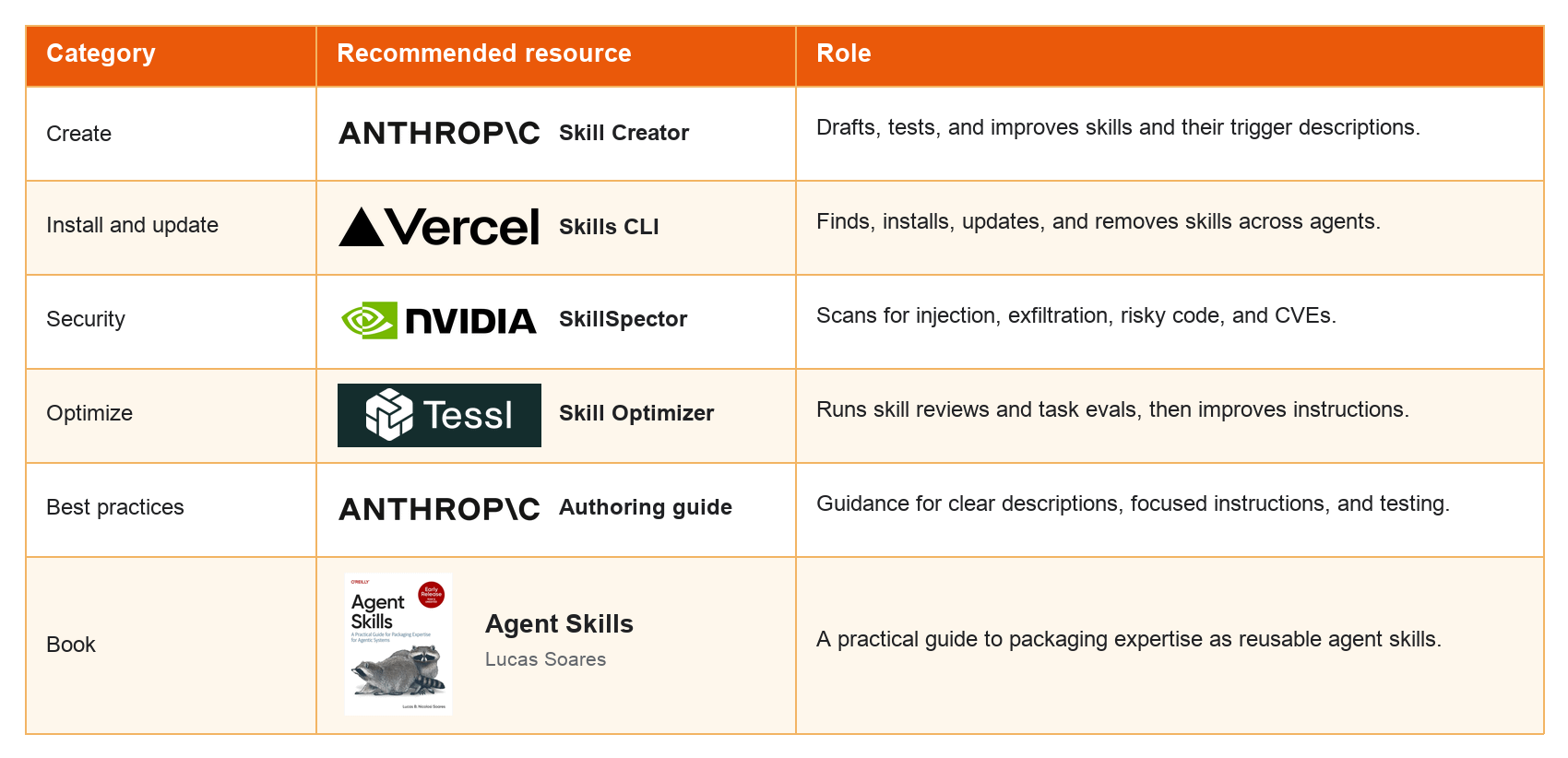
I’ve collected the tools and resources I find useful across the skill lifecycle, with my picks for each step
1. Understand the skill format
Before creating a skill, start with the specification and these guides to the format, structure, and authoring practices.
Agent Skills specification defines the
SKILL.mdformat, required metadata, optional resources, and progressive disclosure.Agent Skills best practices explains how to scope skills, structure instructions, manage context, and decide what belongs in a skill.
Anthropic’s skill authoring best practices provides practical guidance on descriptions, triggering, instruction writing, and testing.
Claude Code skills documentation covers how Claude Code discovers, loads, and manages skills, with examples and configuration options.
2. Create skills with skills
You can learn skill authoring by studying skills that create, review, or improve other skills, sometimes called meta skills. A few interesting examples:
Anthropic’s skill-creator is my starting point for general-purpose skill creation. It supports drafting, creating test cases, running evaluations, and improving the skill through repeated iterations. The evaluation loop is more interesting than the initial template.
BrowserAct Skill Forge explores websites and turns repeated browser operations or data extraction tasks into reusable skills with supporting scripts. Useful when you want to automate an existing browser workflow.
Skill Seekers takes a different approach. It extracts information from documentation, repositories, PDFs, and other sources and packages it into skill resources. Useful when the knowledge already exists, but needs to be structured for an agent.
Matt Pocock’s grilling skill is not a skill creator, but worth studying. It questions the user systematically to clarify a plan or decision. That is often the missing step when creating skills: understanding the task before writing the instructions.
These projects solve different problems. I would not use all of them to create a single skill. Pick the one that fits your source material and workflow, then inspect its own SKILL.md to understand how it works.
3. Discover and install skills
Several registries and marketplaces help you discover agent skills. They overlap, but each has a slightly different focus.
skills.sh by Vercel is one of the best starting points. It has a large collection of community skills with install-based rankings, trending skills, and categories. Useful for discovering what developers are actually installing.
SkillsMP indexes a large number of public
SKILL.mdfiles from GitHub. Its strength is broad coverage, with search across categories, creators, and repositories. Useful for finding less popular or specialized skills.ClawHub focuses on the OpenClaw ecosystem. It provides a registry of skills with download counts, categories, and version history. A good starting point if you use OpenClaw.
Tessl Registry goes beyond listing skills. It provides quality assessments and evaluations to help developers compare skills based on more than popularity.
Skills Directory focuses on searchable skills with security analysis and categorization to help evaluate third-party skills before installation.
For trusted starting points, also explore the official skill collections from Anthropic, OpenAI, and Google. These are GitHub repositories rather than registries, but useful sources of examples.
Search across registries
Rather than browsing each registry separately, these two tools make it easier to discover and install skills directly from your coding agent:
Vercel Skills CLI lets you search skills.sh using
npx skills find, install skills from GitHub, and manage installed copies across supported coding agents. It can also create a starterSKILL.mdand try skills without permanently installing them.Universal Skill Finder is my project for searching across multiple registries, including skills.sh, SkillsMP, ClawHub, and Tessl, as well as GitHub repositories and local skill folders. It combines and ranks results so you don’t have to repeat the same search across different sources.
Finding a skill is only the first step. Before installing one, inspect its instructions and scripts, check the permissions it requires, and test whether it actually improves your agent’s results. Popularity is not a measure of quality or security.
4. Validate, test, and improve
A skill that follows the specification isn’t necessarily useful. And a skill that works isn’t necessarily safe.
These resources address different aspects of skill quality:
skills-ref is a reference implementation for validating skill structure and metadata. Good for catching format errors, although its maintainers describe it as a demonstration library rather than production tooling.
NVIDIA SkillSpector is a security scanner for agent skills. It looks for prompt injection, data exfiltration, unsafe code patterns, and other risks. Particularly useful when inspecting third-party skills. A clean scan doesn’t guarantee safety, but it is a useful first check.
Tessl skill-optimizer combines skill reviews with task-based evaluations. It can compare results with and without a skill, identify weaknesses, and help improve its instructions. The difference between baseline and skill-enabled results is what matters.
For a skill I plan to reuse, I would start with a few simple tests: a request that should trigger the skill, a similar request that should not, and a real task executed with and without the skill.
Then I’d check whether the agent invoked the skill correctly, followed the instructions, and produced a better outcome.
If the skill runs code, reads local files, or accesses external services, I’d check those permissions separately. Functional correctness and security are different concerns.
5. Learn more about agent skills
There is already a growing collection of guides and research on skill authoring. These are the ones I would recommend for a deeper understanding.
Official guides
Anthropic’s Complete Guide to Building Skills for Claude is a good introduction for your first build. For more background, read Anthropic’s engineering article on Agent Skills and its step-by-step creation guide with examples and limitations.
Practitioner guides and research
How to Write an Agent Skill by Alejandro Saucedo at the Institute for Ethical AI & Safety. An opinionated guide with concrete good and bad examples. I particularly like its distinction between deterministic scripts and the decisions we should leave to the agent.
How to Write Effective AI Agent Skills by Laurie Voss at Arize. Six research-backed practices covering skill scope, routing, model-specific behavior, and evaluations. A useful reminder that longer instructions are not necessarily better.
Building Skills for AI Agents: Pitfalls and Best Practices by Red Hat’s Applied AI team. A practical write-up based on building a root-cause analysis skill. It covers the trade-offs between scripts and LLM reasoning, skill portability, context optimization, and continuous evaluation. Particularly relevant when treating skills as maintainable software artifacts.
SkillReducer: Optimizing LLM Agent Skills for Token Efficiency is a research paper analyzing 55,315 public skills. It identifies problems with missing descriptions, unnecessary instructions, and excessive context usage. The authors propose optimizing skill routing and instructions through compression and progressive disclosure. Worth reading before adding another few hundred lines to your
SKILL.md.
A book for the longer read
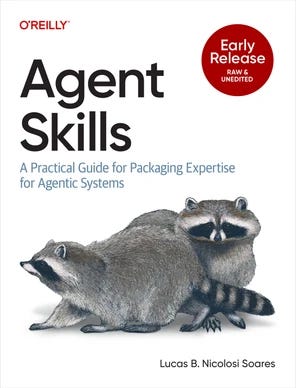
For a more comprehensive treatment, take a look at Lucas Soares’s upcoming O’Reilly book, Agent Skills. I’m a reviewer for the book. It covers skill design, practical patterns, use cases, and how skills fit into the broader agent ecosystem. The contents are still being finalized.
If you know a good resource for creating, testing, or managing agent skills, share it in the comments and I’ll add it to the collection.
👋 Found this useful? Like and restack it for other software engineers.
Agreed that the hard part isn't writing the SKILL.md, it's getting the agent to pick it at the right moment. If someone only has time for one tool on this list, which one would you point them to?