

Docker popularised containers as a way to package, isolate and run microservices, and Kubernetes became the de facto standard for orchestrating them at scale. Today it is one of the largest developer ecosystems, with tools, libraries and service providers.
So isn't Kubernetes also the best place to run AI agents? What changes when the workload is an agent?
Consider a coding agent working on a repository. It might spend minutes waiting for a reply, then write and run a script, call a remote API, and push a change on someone’s behalf. Each part of that session asks something different of the infrastructure, because an agent doesn’t behave like the services Kubernetes was built to run. Four characteristics set it apart.
1. High idle time
An agent session can stay open long after its local environment runs out of work. The agent might be waiting for a user to approve a change, an LLM to respond, or a remote test run to finish. An interactive agent can spend up to 95% of its session idle, though the proportion depends on the application.
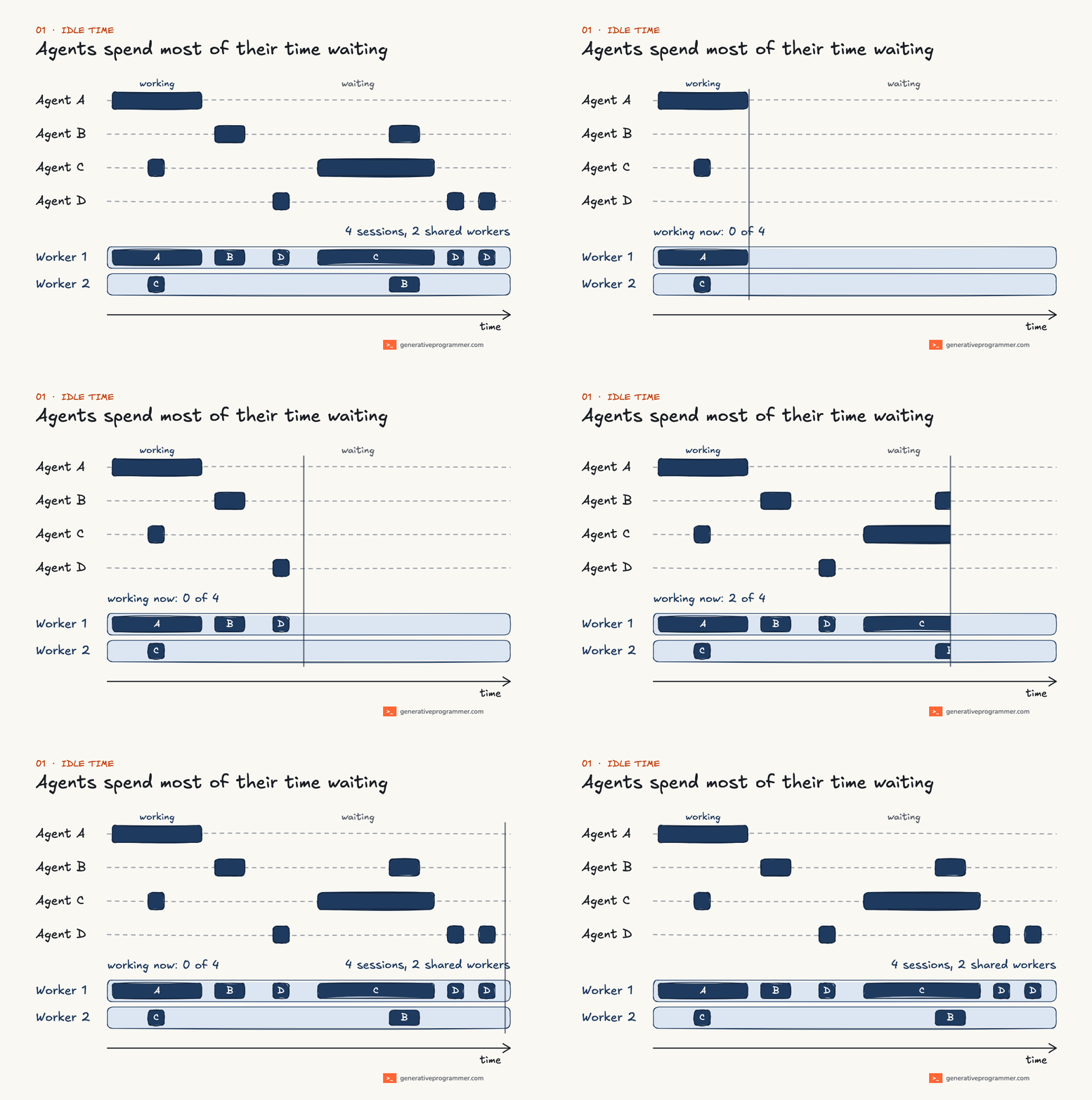
One agent might work in short bursts throughout the day. Another might spend a few minutes editing a repository, then wait hours for a review. In both cases, the agent needs local compute for only a fraction of the time its session stays open. Give every session its own Pod and you end up reserving memory for thousands of agents even when only a handful have work to do.
Agent Substrate separates the lifetime of a session from the lifetime of its worker Pod. When the application decides it’s safe to suspend the session, Substrate takes a snapshot and frees the worker for another agent. The session can later resume on a different worker. This is temporal multiplexing, much like CPU time-sharing, but at the level of agent environments. Worker reuse
2. Nondeterministic behaviour
When a coding agent resumes, what code will it run? In a conventional microservice, developers supply the code and define the available execution paths. An agent can choose its next action at runtime. Give it a shell tool and it can write a Python script to transform files in the repository, then execute that script immediately.
That script runs with whatever access the environment gives it. It can modify files, spawn processes, or try to reach the host and neighbouring workloads. The isolation boundary has to hold regardless of what the model decides to execute.
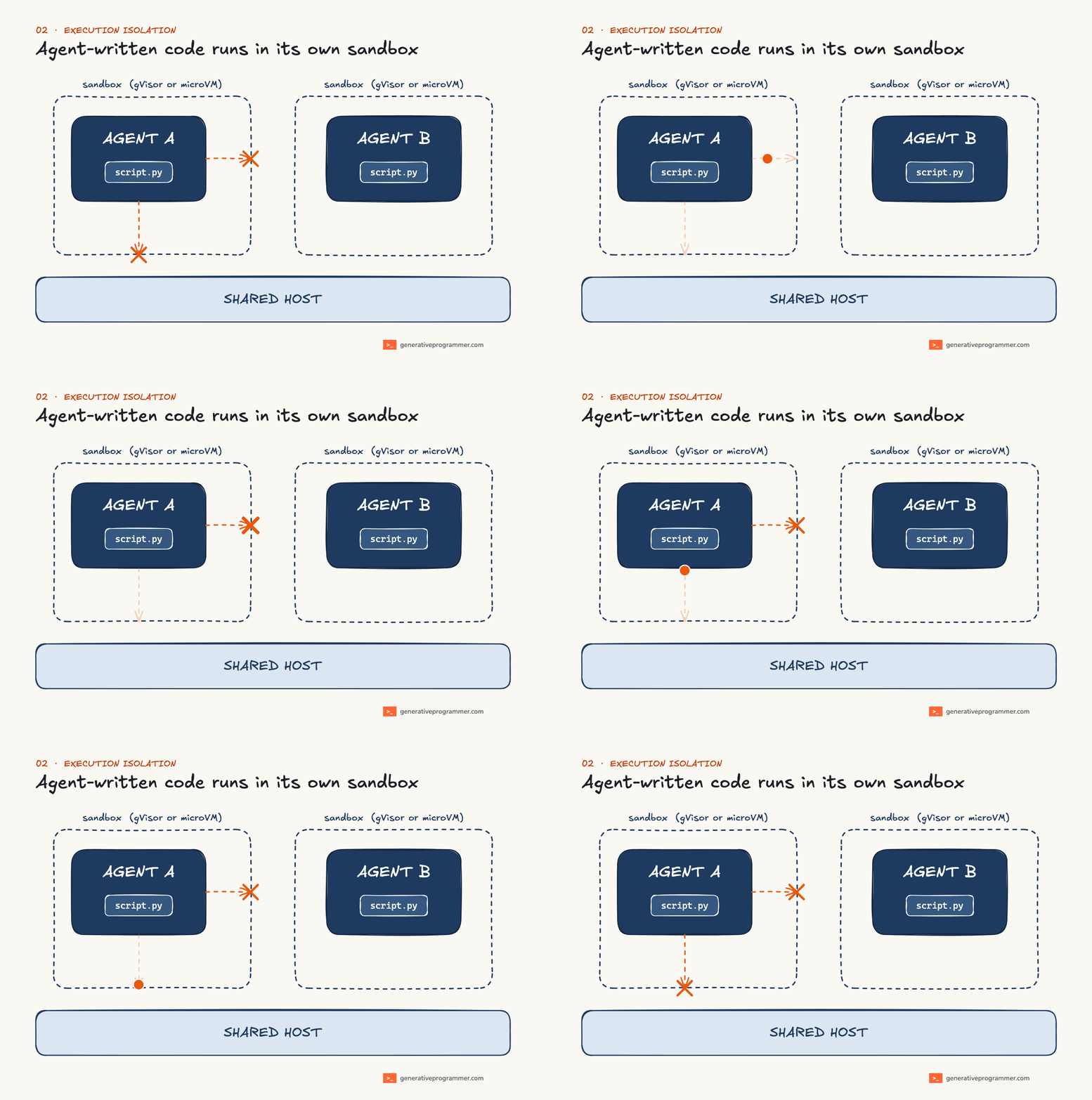
Substrate gives each active agent its own gVisor or microVM sandbox. Agents can take turns using the same worker Pod while each retains its own execution boundary. Sandbox isolation
3. Dynamic network access
A script can stay inside its sandbox and still send proprietary code to an external endpoint. Our coding agent may need access to the repository and an approved model endpoint. It has no reason to upload files to an arbitrary internet destination. When the model chooses which requests to make, controlling outbound traffic matters as much as protecting inbound access.
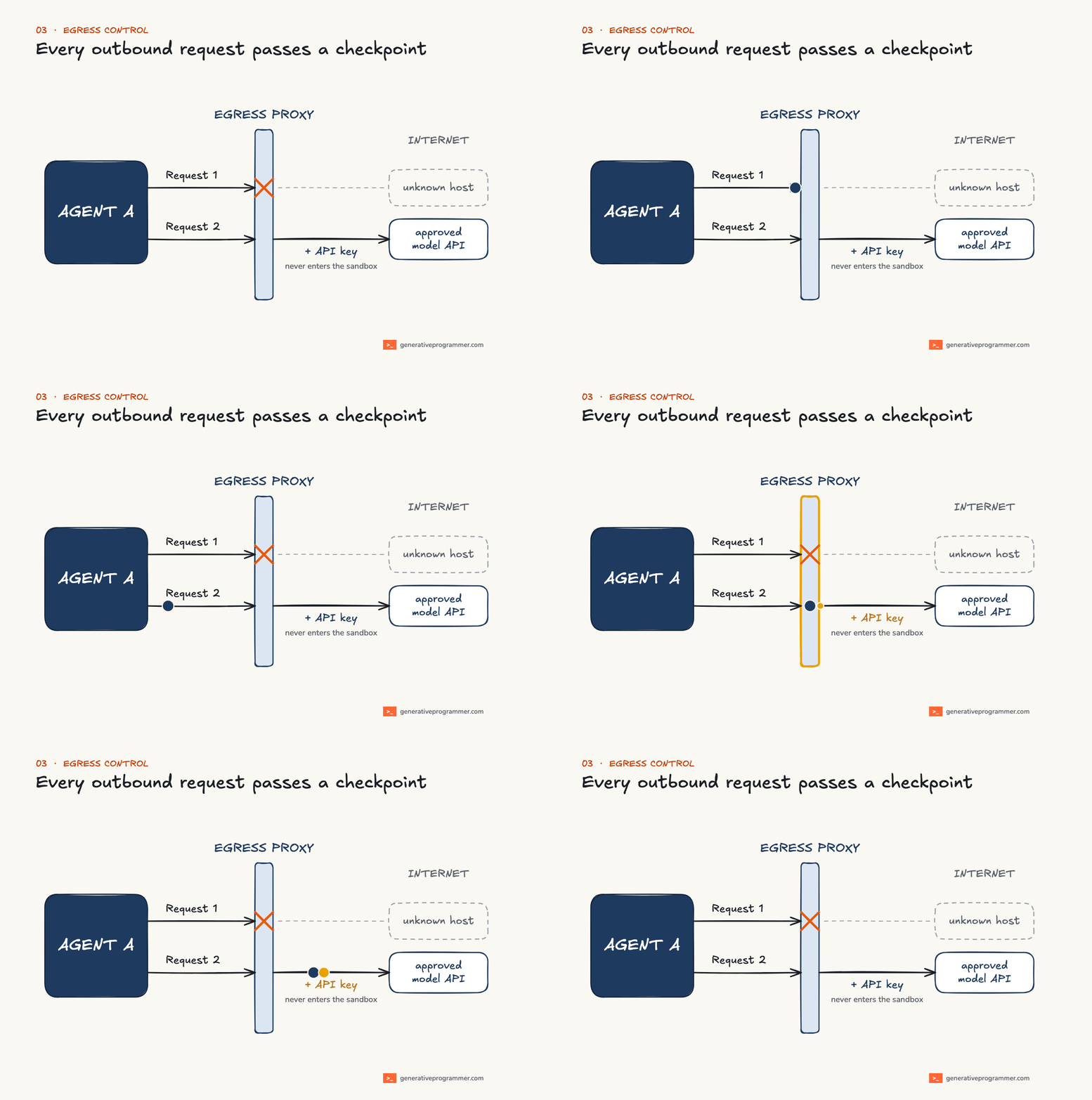
Even an approved model endpoint can receive a prompt containing personal information or proprietary code. The destination tells you where the request is going. It tells you little about what the agent is sending.
Substrate mediates ingress and egress and applies policy to DNS lookups. Its egress gateway checks the destination and can add an API key or token to an approved request. The credential stays outside the sandbox. Inspecting or filtering the payload requires an additional policy, and the receiving API still has to authorise the operation. Network controls
4. Delegated authority
Two users ask the same coding agent to push a change. One has write access to the repository. The other can only read it. How does the repository know which request to allow?
A microservice commonly has one workload identity for the whole service. Here, the API also needs to know which agent session is acting, whose permissions it is using, and for how long. The session needs an identity that follows it when it moves to another Pod.
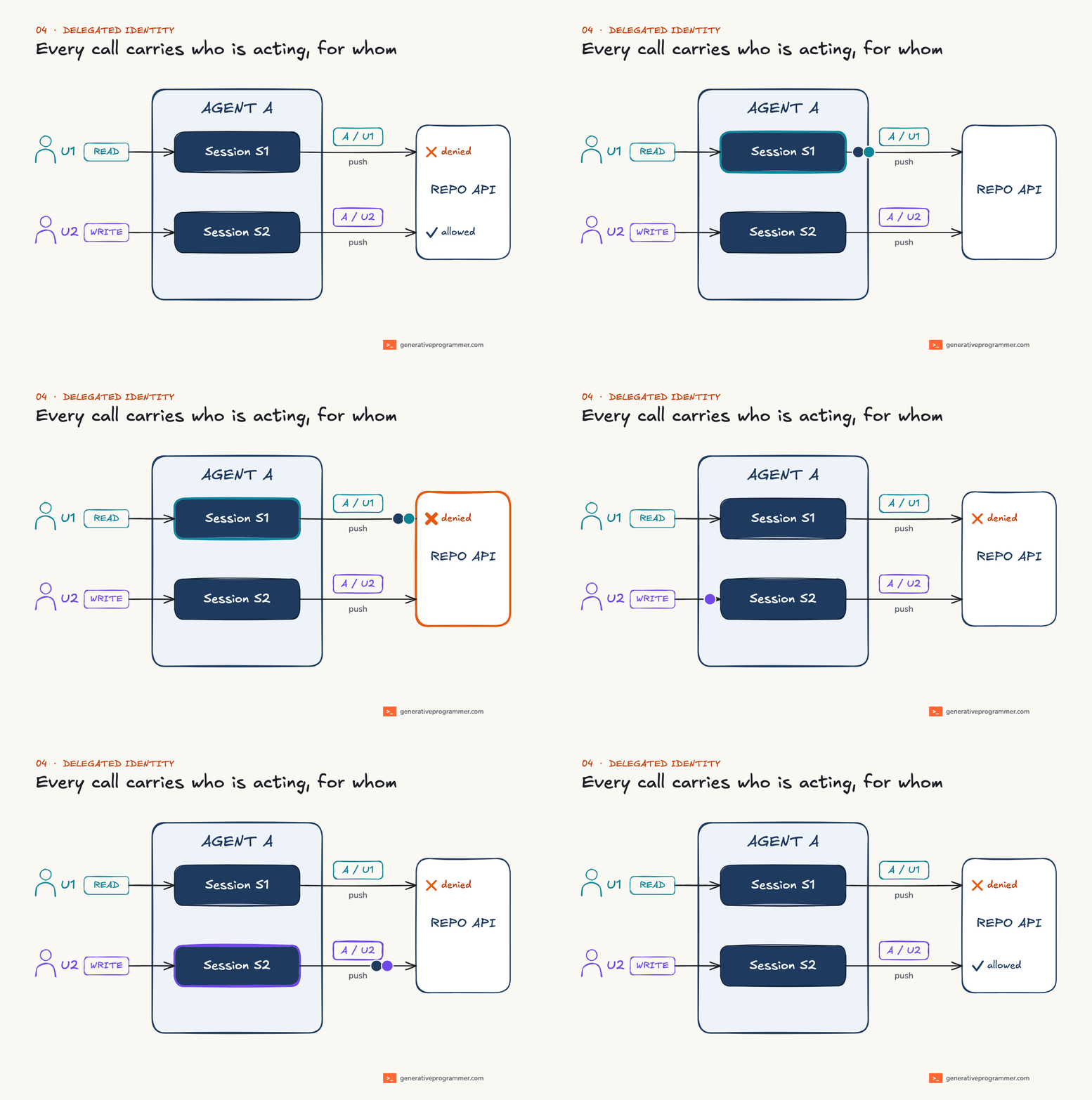
If the agent pushes a change, you need to be able to trace it back to the session that made the request and the user who authorised it. That context can span more than one token.
Substrate gives each agent a short-lived SPIFFE certificate and can issue an agent JWT on demand. The application authenticates the user and maps their authority to the session. To carry that authority through to a backend, the application needs to integrate with the relevant identity systems. OAuth 2.0 Token Exchange is one way to obtain a delegated token with limited permissions and a short lifetime. Native on-behalf-of flows in Substrate are still under design. Identity overview
Where this goes next
Agent Substrate is the underlying runtime, and it is generic. It deals in actors, sandboxes and snapshots, and knows nothing about prompts, models or tools.
kagent is the agent abstraction on top. You create an agent and talk to it from kagent, and kagent runs it on Substrate for you. You never have to think about actors, worker Pods or snapshots. agentgateway sits on the egress path, between the agent and the models, tools and APIs it calls.
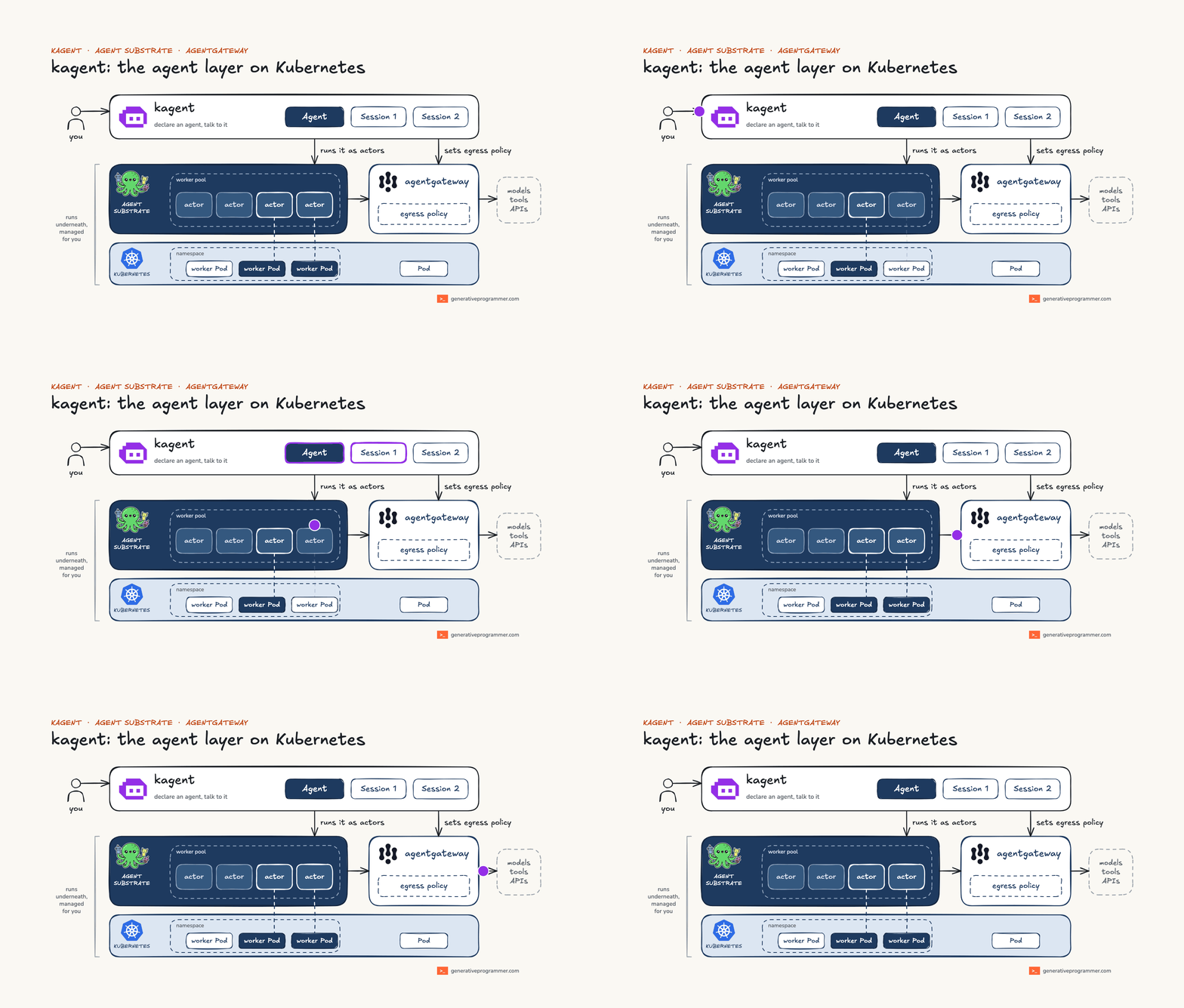
I'm working on a follow-up on how Agent Substrate, kagent and agentgateway fit together. To catch it, subscribe on Substack or follow me on X and LinkedIn.
An agent idle 95% of its session and still holding a Pod is a horse renting a whole stall to nap in. Snapshotting it and lending the stall to the next one is exactly the kind of thrift I love to see.
The egress proxy needs a content check, not just a destination list: an approved endpoint can still receive proprietary code in the prompt. Test it with one secret sent to an allowed endpoint.