
Key takeaways
AI-assisted coding moved from autocomplete to agentic code generation.
That shift made planning a first-class step. Serious teams now start with a spec or a plan before the agent touches the codebase.
Build split into two paths: full-stack app builders for prompt-to-product flows, and local developer agents for working inside real repos.
The biggest new category is local developer agents, especially CLI-native ones.
Async cloud agents are still early, but they point to a delegated model where coding work runs in the background or overnight.
AI-assisted review is becoming the only practical way to keep up with the volume of AI-generated code.
I wrote about this landscape last year in AI Coding Assistants Landscape (03/2025). The picture is simpler now. The big change is not only that the tools got better. The workflow changed. Not long ago, the center of the story was autocomplete and inline suggestions. In 2026, the center is agentic code generation guided by a plan, followed by stronger review before code ships.
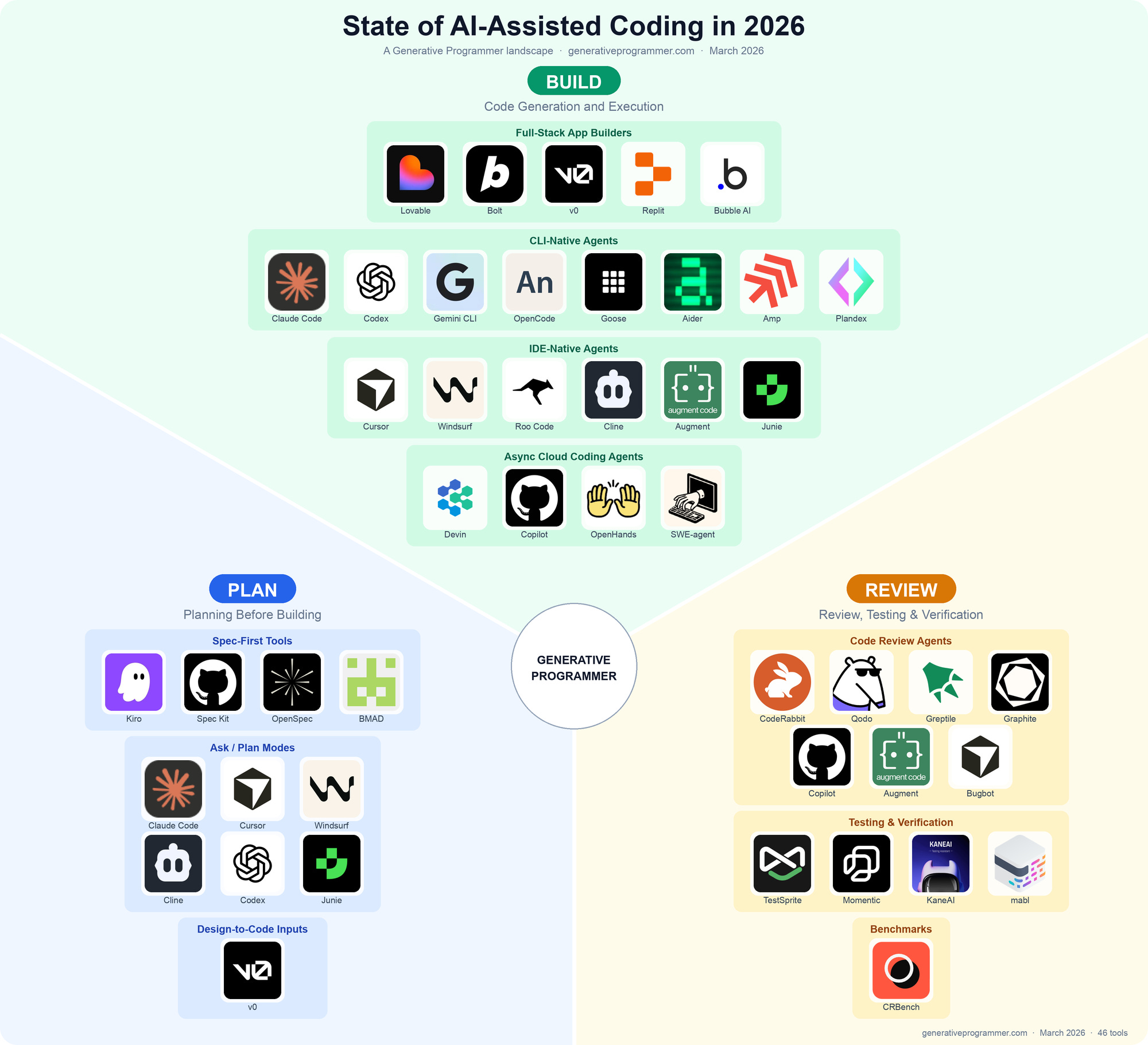
This is an opinionated map of how the market is organizing itself. The easiest way to understand the ecosystem now is through a simple sequence: plan the work, build it with agents, then review what they produced.
1. Plan
The first major shift is that planning stopped being optional. Teams learned the same lesson from multiple directions: if the plan is weak, the build drifts, the review catches more noise than signal, and the whole agent loop becomes harder to trust.
This planning layer now shows up in two forms. There are dedicated spec-driven tools that formalize planning as a standalone practice, and there are build tools that pulled planning into their core workflow.
1A. Dedicated planning and spec-driven systems
Spec-driven development is the clearest expression of this change. These tools turn vague prompts into requirements, acceptance criteria, design notes, and implementation tasks before code generation begins. If vibe coding is “start building and see what happens,” spec-driven development is the counterweight: decide what you are building first, then let the agent execute.
Kiro, a productized example of spec-driven development that turns prompts into structured requirements, design artifacts, and task plans.
GitHub Spec Kit, GitHub’s open source toolkit for spec-first workflows and implementation planning.
OpenSpec, a lighter open source framework for writing reusable specs for coding agents.
Beyond coding-specific spec tools, broader frameworks such as BMAD-METHOD show that structured AI-assisted planning is also expanding into higher-level delivery and agile workflows. The pattern is the same: teams that invest more in upstream intent get more predictable downstream results.
2B. Planning modes inside build agents
Planning is not confined to dedicated planning tools anymore. The stronger signal is that serious build tools now expose ask, plan, explore, or read-only modes before they touch the codebase. That is the clearest sign that planning became part of the agent loop itself, not something attached later.
Claude Code, exposes Plan Mode for safe code analysis before editing.
Cursor, uses Ask mode for exploration, questions, and planning before execution.
Windsurf, treats planning as a built-in part of the Cascade workflow.
Cline, makes the split explicit with a Plan and Act workflow.
Codex, separates Ask mode from Code mode.
Junie, uses Ask mode to collaborate on an action plan before making changes.
One related shift worth noting is that planning is no longer only text. Screenshots, Figma files, and mockups are increasingly becoming structured inputs into the coding workflow. I would not treat that as a separate category yet, but it matters as a bridge from planning into building. v0 screenshots and files is one obvious example, and the broader full-stack app builders category is also moving in this direction by making design artifacts directly usable for PMs, designers, and non-technical builders.
2. Build
This is where the market split most visibly. It is no longer useful to talk about “AI coding tools” as one bucket. Build is now best understood through three practical categories: full-stack app builders, local developer agents, and async cloud coding agents.
The most important change for developers is that local developer agents became the default serious workflow. But before getting there, it is worth separating them from the other branch: full-stack app builders.
2A. Full-stack app builders
This is the category where vibe coding became productized. These tools combine generation, iteration, preview, runtime, and deployment in one surface. They are not just code generators. They are prompt-to-product environments, closer to “build me the product” than “work with me inside my repo.”
This category matters because it serves a broader audience than professional developers: founders, PMs, designers, mixed-role teams, and non-technical builders. It is the closest thing we have to software creation for everyone, and it is expanding the definition of who can build software in a meaningful way.
Lovable, full-stack app builder aimed at turning prompts into working products quickly.
Bolt, browser-based full-stack builder with generation, preview, and deployment in one loop.
v0, Vercel’s AI full-stack app builder with strong UI, design, and production handoff workflows.
Replit Agent, browser-native environment that can generate, run, debug, and deploy applications.
Bubble AI, AI-assisted visual app builder closer to no-code product creation than to local repo development.
2B. Local developer agents
This is the biggest change in the market. The story is no longer “which autocomplete tool is best?” It is “which agent loop do you want to build your workflow around?”
Claude Code helped make this category mainstream, especially on the terminal-native side. But the larger shift is broader than any single tool. The strongest open source and commercial energy now clusters around local agents that can plan, edit, run commands, inspect outputs, and iterate, all inside a real development environment, with the developer supervising the loop. This is where professional software engineering lives in 2026.
CLI-native developer agents
Terminal-based development is now a category in its own right. This is the branch where agentic coding feels most explicit and most professional. It keeps the repo, the terminal, the test loop, and the engineering workflow at the center, rather than wrapping them behind a simplified interface. Not long ago, terminal-native agents were a niche. Today, some of the fastest-growing open source projects in the AI-assisted coding space are terminal-first.
Claude Code, the terminal-native coding agent that made the category mainstream.
Codex, OpenAI’s local coding agent that also extends into cloud delegation.
Gemini CLI, Google’s open source terminal agent with strong community adoption.
OpenCode, a fast-growing open source coding agent with built-in plan and build agents.
Goose, open source local agent for install, execute, edit, and test loops.
Aider, Git-first terminal coding assistant that remains highly popular with working developers.
Amp, Sourcegraph’s terminal agent with deep code intelligence and codebase-wide context.
Plandex, a terminal agent designed for larger tasks, planning, and sandboxed diffs.
IDE-native developer agents
The IDE-native tools matter just as much, but their mental model changed too. Even in IDEs, the direction moved away from inline completion and toward planning, tool use, command execution, multi-file edits, and local review. The IDE is still the surface, but the agent loop is now the core interaction, not the autocomplete dropdown.
Cursor, the bridge product from AI-native IDE to full local agent workflow.
Windsurf, an IDE-native agent centered on planning, editing, execution, and verification.
Roo Code, a popular open source editor agent with architect, ask, code, and debug modes.
Cline, an open source IDE agent with a clear plan-then-act workflow.
Augment, a context-heavy developer agent that also stretches into review.
Junie, JetBrains-native coding agent for planning and implementation inside the existing IDE workflow.
2C. Async cloud coding agents
This is the delegated branch of the build step. If local agents are “pair with me,” cloud agents are “go do this and come back.” These tools run in remote sandboxes, often triggered from issues or pull request workflows, and return with patches, branches, or pull requests.
This category is smaller than local agents today, but the workflow matters. It is the beginning of a mode where you hand work to an agent from GitHub, or at the end of the day, and let it run while you are doing something else or simply sleeping. That is why I expect this category to grow even if it still feels early.
Devin, the flagship async remote coding agent for delegated engineering work.
Codex cloud, OpenAI’s sandboxed remote execution model for delegated coding tasks.
GitHub Copilot coding agent, GitHub-native delegation from issues and pull request workflows.
OpenHands, the open source alternative for issue-to-patch and cloud-agent workflows.
SWE-agent, an influential open source issue-to-patch system that bridges research and practice.
If you want to go deeper on the delegated, async side of this market, this background agents landscape is worth reviewing. It offers a curated map of tools and infrastructure layers behind these workflows.
3. Review
Once agents started writing much more code, review became the new bottleneck. The point of this step is simple: keep the speed of AI code generation without letting quality collapse.
Code generation accelerated faster than our ability to inspect the output manually. That gap is what pulled review into its own category. The strongest part of this layer today is code review. Testing and verification are still lighter, but they are growing quickly as browser-based agents and cloud runtimes become more capable.
3A. Review agents
The most interesting shift in review is timing. AI review is no longer only something that happens after a pull request exists. The stronger tools now review code locally, before commit or before the PR is opened, and then review again once the PR is live.
That creates a two-stage loop: local review first, shared PR review second. It is one of the clearest signs that review is becoming part of the development loop itself and not only a separate final gate.
Qodo, is built for enterprise-scale review, using dedicated agents, codebase context, PR history, and team rules to review changes before they reach the PR and again at review time.
CodeRabbit, an AI reviewer that now spans pull requests, IDE reviews, and CLI reviews before commit.
GitHub Copilot code review, GitHub-native review in pull requests, now complemented by local review in supported tools.
Augment Code Review, a PR reviewer that routes findings back into the IDE or CLI for fixing.
Cursor Bugbot, a mostly PR-native automated reviewer focused on catching real bugs with low noise.
Greptile, a context-aware reviewer focused on repo-wide reasoning over pull requests.
Graphite Agent, an AI reviewer integrated into Graphite’s stacked pull request workflow.
3B. Testing and verification agents
This is a lighter category than review today, but it is easy to see why it could become much bigger. As browser-based agents, cloud Chromium environments, and agentic end-to-end testing get stronger, more of the validation work that currently lives in manual QA can move into automated review loops.
For now, testing and verification still belong inside the same review step. If review agents inspect diffs, this emerging branch inspects behavior. That distinction will matter more as the code being generated grows in scope and complexity.
TestSprite, an intent-to-tests workflow that generates, runs, and explains tests.
Momentic, a browser testing agent focused on end-to-end validation.
KaneAI, an AI testing agent for browser and workflow automation.
mabl Agentic Testing, agentic test creation and maintenance for UI flows.
There are also benchmarks starting to emerge around this review layer. Code Review Bench from Martian is worth watching because it treats code review as a useful foundation for measuring code generation quality and validation, combining an offline benchmark with real developer behavior from open source pull requests.
Appendix: enterprise incumbents and platform suites
These tools still matter, especially in enterprise buying conversations, but they are not the sharpest lens for explaining how the market changed:
Amazon Q Developer, an AWS-integrated developer assistant and terminal agent.
Gemini Code Assist, Google’s enterprise coding assistant across IDEs and cloud workflows.
GitLab Duo, GitLab’s integrated AI layer across the software delivery lifecycle.
Tabnine, a long-running enterprise AI coding assistant focused on controlled deployments.
watsonx Code Assistant, IBM’s enterprise tool for code generation and modernization.
TONGYI Lingma, Alibaba’s coding assistant for enterprise and cloud workflows.
Refact.ai, a self-hostable coding assistant with strong enterprise positioning.
Implications
If this framing is right, a few implications follow for how we work and what we invest in.
→ Planning will increasingly become the starting point, not an afterthought. The best coding tools already start with a plan before generation, and teams that skip this step will find themselves debugging drift rather than building features.
→ Full-stack app builders will keep pulling in design, product, and prototyping workflows. This is expanding who can create software, and that expansion is not slowing down. For product managers, designers, and founders, these tools are becoming the default way to go from idea to working prototype.
→ Local developer agents will keep taking share from autocomplete-first tools because they fit better with how professional developers already work, inside a real repo, with real tests, in a real terminal or IDE. Developers who learn to work effectively with agent loops will have a meaningful advantage over those still treating AI as a smarter autocomplete.
→Async cloud coding agents will grow as delegation becomes more natural. Send work from GitHub or at the end of the day, and let it run in the background. This mode is still early, but it is the beginning of a shift where engineering work does not have to be synchronous.
→ Review is becoming the next bottleneck and the real quality gate in software delivery. As code generation gets better, review will have to become far more sophisticated too. That is where the next major gains in software quality will come from.
→ Testing is still earlier than review, but it is the clearest next expansion area for agentic tooling. As browser-based testing agents improve and cloud runtimes become cheaper, this is where confidence will grow fastest.
My takeaway: AI-assisted coding is no longer one tool category. It is becoming a connected workflow from planning, to building, to gaining confidence in the result. Teams that understand these layers will be better positioned to adopt the right tools at each step. I share similar analysis on X: https://x.com/bibryam and in this newsletter.