

After two years in stealth, Diogo Almeida, one of the researchers behind ChatGPT, launched Jev at TypeSafe AI. The company advertises roughly 200 times faster and 400 times cheaper decisions than LLMs, based on its own workflow evaluations. TypeSafe says those gains are at the high end of what it expects in practice.
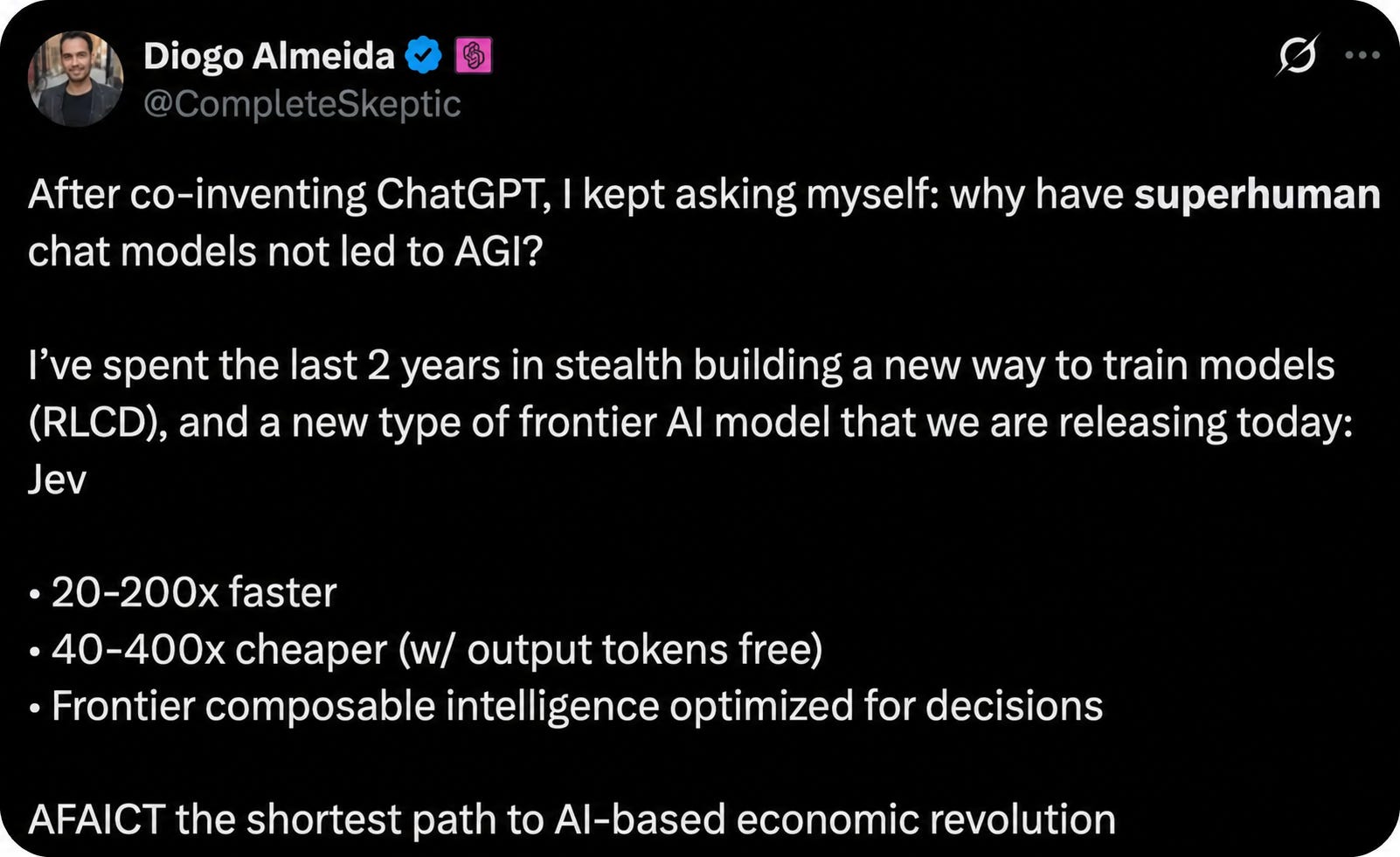
Almeida’s launch announcement, 15 September 2026.
Many LLM calls only need a classification, a choice, or a score. If Jev can deliver those judgments reliably at much lower latency and cost, developers can replace expensive calls and add AI to interactions where waiting for generated text would be too slow.
What is Jev?
Jev is TypeSafe AI’s model for structured decisions. You give it context and questions with defined answer types. TypeSafe calls this a System One model, borrowing the idea from Daniel Kahneman’s Thinking, Fast and Slow. In this analogy, reasoning LLMs resemble the slower, deliberate System 2, while Jev handles the quick judgments associated with System 1.
Here’s a minimal Hello World using Vercel AI SDK 7+:
import { experimental_evaluate as evaluate } from 'ai';

const { answers } = await evaluate({
  model: 'typesafe-ai/jev',
  state: 'Hello, world!',
  questions: {
    greeting: { type: 'boolean', instructions: 'Is this a greeting?' },
  },
});
console.log(answers.greeting.probability); // Example output: 0.97
The input is “Hello, world!”. The output estimates the probability that it is a greeting. Vercel calls this question type boolean; TypeSafe’s native API calls it noul. It returns a number from 0 to 1, and your code chooses what to do with it.
You can also ask for a choice or a score:
Choice selects from options you define, such as
billing,technical,sales, orother, and returns each option’s probability.Score evaluates against ordered descriptions. On a frustration scale of 0 = calm, 1 = concerned, 2 = angry, a score of
1.8is a probability-weighted position between concerned and angry. It is not a confidence percentage.
For the message “Charged twice. I’m furious. Please refund the duplicate.”, an application could ask whether the customer wants a refund, which department should handle it, and how frustrated they sound.
A traditional autoregressive LLM generates its response token by token. You can constrain that response to JSON; any probabilities it writes are prompted estimates. Jev evaluates independent questions in parallel, using the same state, and returns typed answers without generating a text response.
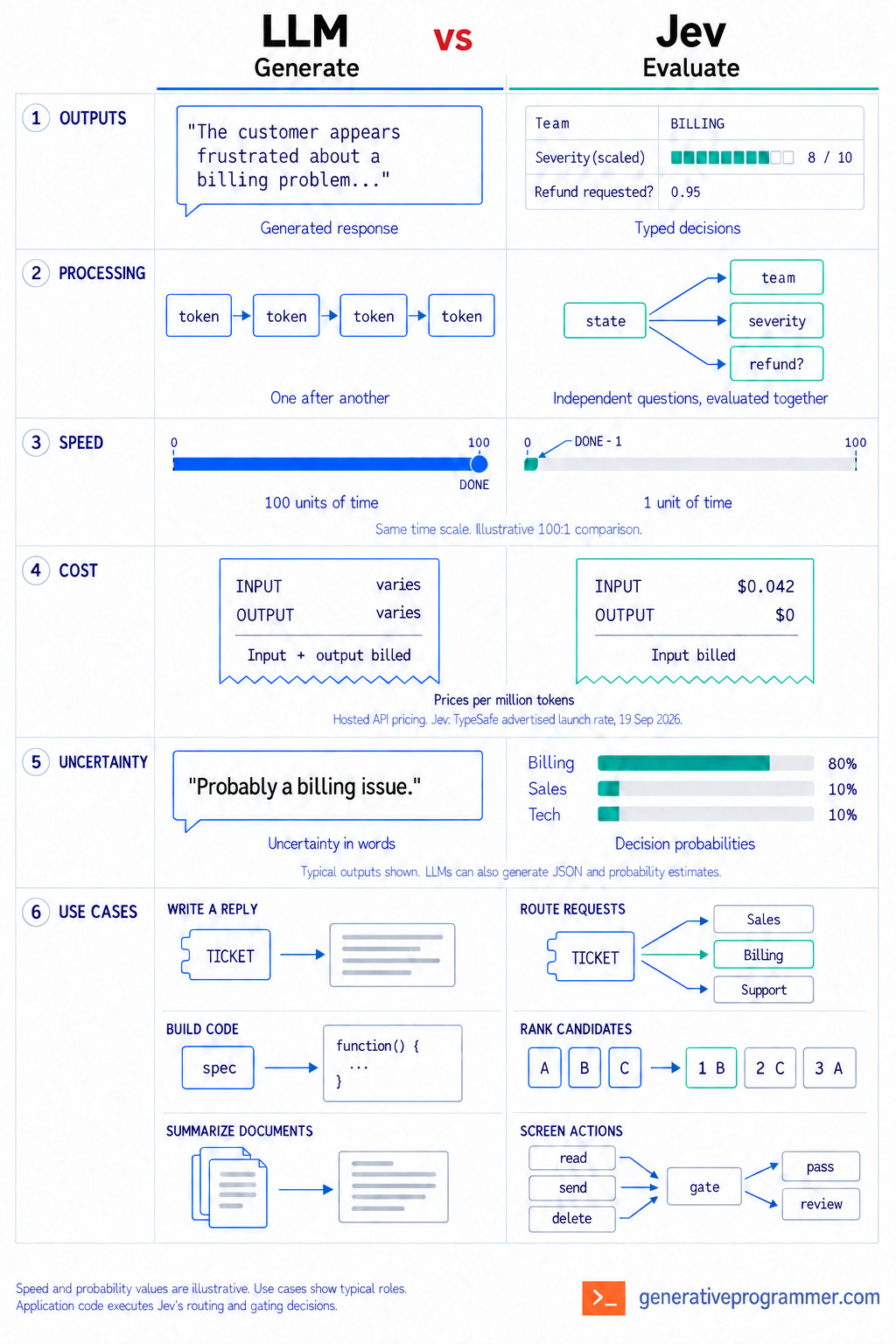
Illustrative outputs and speed ratio. Severity is scaled to 0 to 10 for display. Prices are TypeSafe’s advertised launch rates.
These three questions fit one request because none depends on another answer. A decision that needs an earlier result requires another request. Your code still checks refund eligibility and permissions. Jev could classify the message while an LLM writes the reply.
TypeSafe currently has a waitlist. You can also access Jev through Vercel’s /v1/evaluate endpoint or Cloudflare, using the model ID typesafe/jev.
What people are building with Jev
Made with Jev collects projects, demos, and guides. The eight below include prototypes and experiments alongside a live app. Jev Ultrafast and Fast Jev Compaction have attracted thousands of GitHub stars; I picked the others for the use cases they demonstrate.
1. Browser control: Jev Ultrafast
This browser agent gives Jev the available operations and page elements. Jev chooses the action and target. When the agent needs to type, a separate small LLM supplies the text.
2. Context filtering: Fast Jev Compaction
This Claude Code plugin and library scores tool calls and results, then retains, drops, or truncates them. It replaces some summarization with selection. Retained content stays verbatim, though discarded content can matter later.
3. Database filtering: pg-jev
This PostgreSQL extension lets you filter rows with a natural-language description or score their relevance. Jev judges the row content; SQL handles the rest of the query.
4. Sponsor skipping: Sponsor Skip
Tony Dinh’s Chrome extension uses Jev to identify sponsored segments in YouTube transcripts and skips them during playback. Jev selects transcript lines; code maps them to timestamps. Optional listening modes use Deepgram for transcription. The prototype requires your own API keys.
5. Predictive launching: Nader Dabit’s launcher
This native macOS launcher uses Jev to rerank local candidates. Local code handles calculations, time filtering, and execution. The user presses Enter to run the selected action.
6. Game control: TypeSafe Mario
Jev chooses actions such as running or jumping. The experimental controller translates emulator memory and telemetry into structured state, including positions and hazards. Jev does not inspect screenshots. The controller observes state, asks for a legal action, executes it, and repeats.
7. Paper classification: 1kpapers
This live research-paper explorer has an experimental Jev classification pipeline. In Hassan’s experiment, a generative model summarizes papers and Jev assigns topics from their titles and summaries. Its creator says he is still evaluating the Jev labels before replacing the existing ones.
8. Simulated flight: Jev Drone
A drone in MuJoCo asks Jev whether to hold course, use a gap, climb, or brake. Code turns camera data into a compact scene description and handles fast flight control.
Where I’d start

My application code after Jev returns a probability.
I’d start with an existing classification or routing call whose possible answers I can write down in advance. Compare Jev with the current implementation on the same labelled inputs, including ambiguous cases. Measure accuracy, end-to-end latency, and full cost, including retries and fallback calls.
Resources
TypeSafe introduction and quickstart: the model’s interface and your first request through the playground, native API, or Python SDK.
Cloudflare REST setup: account credits and a token with Workers AI Read permission. Cloudflare handles provider credentials without a separate TypeSafe key.
Codila: Jev Engineering: a practical introduction covering the playground, a first API call, task routing, and a browser agent.
Greg Isenberg: Jev is HERE. How to use it: a conversation with Ryan Vogel about email triage, business uses, and access.
Matthew Berman: We need to talk about Jev...: a video introduction to the launch.
SemIf, formerly OpenJev: an independent browser experiment comparing direct option probabilities with JSON generation using local open models. It does not run Jev or claim equal quality.
Awesome Jev and Awesome Jev Use Cases: more projects, integrations, and examples.
👋 Found this useful? Like and restack it for other software engineers.