

I ran the same technical draft through four anti-slop and humanizer skills, four separate runs from one file, and I never fed one output into another.
The input was already clean. It had sources, version numbers, caveats, and a clear structure. I had removed most of the easy AI tells beforehand. That made the test useful: the skills could not simply delete stock phrases and declare victory.
I did not get four versions of the same cleanup. I got four editors working at different altitudes.
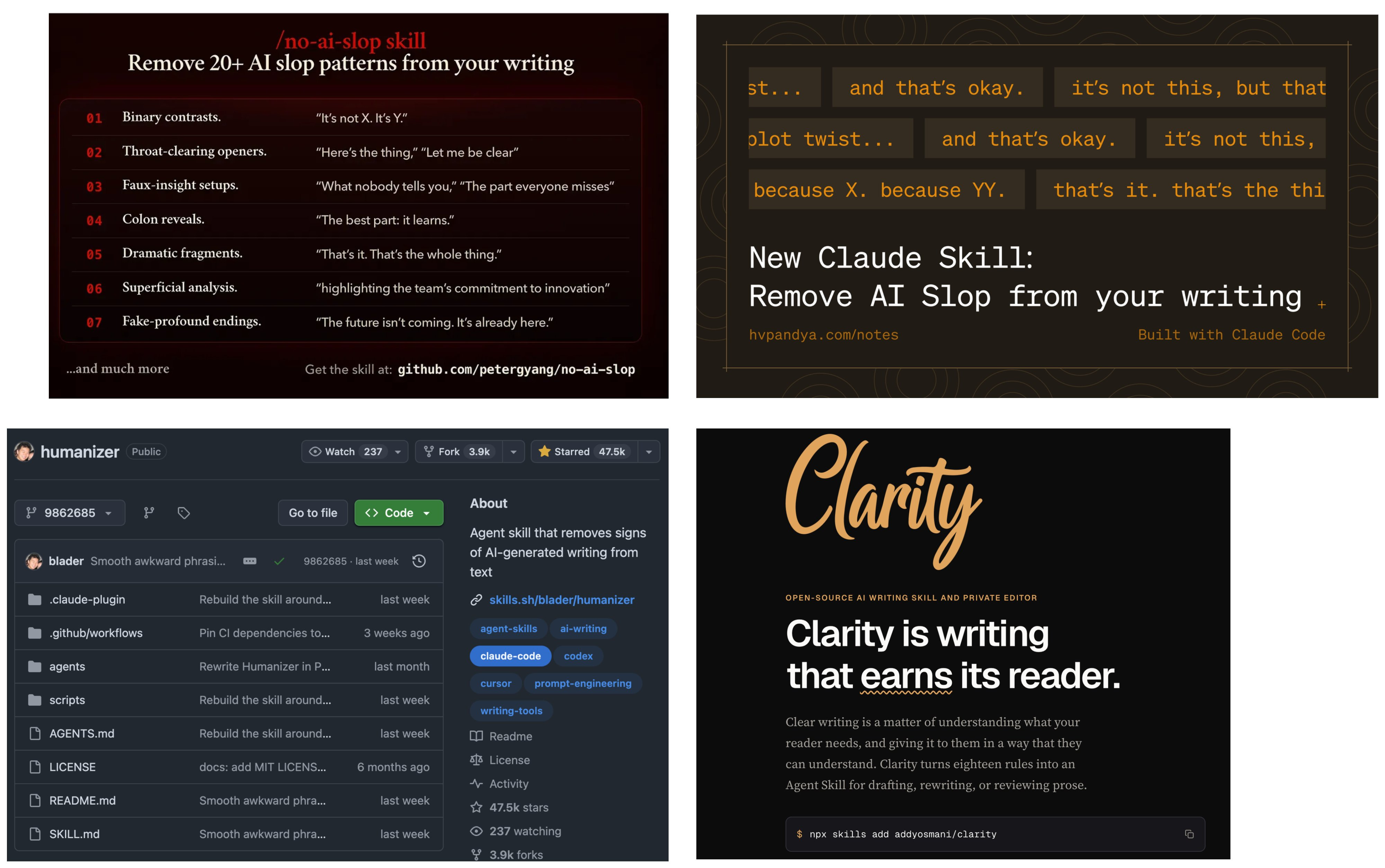
The four are not equally popular. A 12 September snapshot put Humanizer at about 47,000 GitHub stars and Clarity at about 200, while Stop Slop led the skills registry with roughly 14,000 installs against Humanizer’s 6,500. Neither count says anything about what a skill does to a sentence, which is what the runs were for.
1. Humanizer: the lightest hand
Humanizer changed 14 passages by my diff and reduced the draft by one word. Its own summary described five prose edits plus heading changes. One passage can contain more than one edit, so those counts measure different things.
It documents 25 patterns, yet produced the most conservative result. It caught title-case headings, one shallow -ing rider, a repeated list, and a word echo.
Before: “A2UI 0.9.1 is current, and 1.0 remains a candidate.”
After: “A2UI 0.9.1 is current, and 1.0 is still a candidate.”
That restraint is the value: on a solid draft, it fixes recognizable tells without rebuilding the argument.
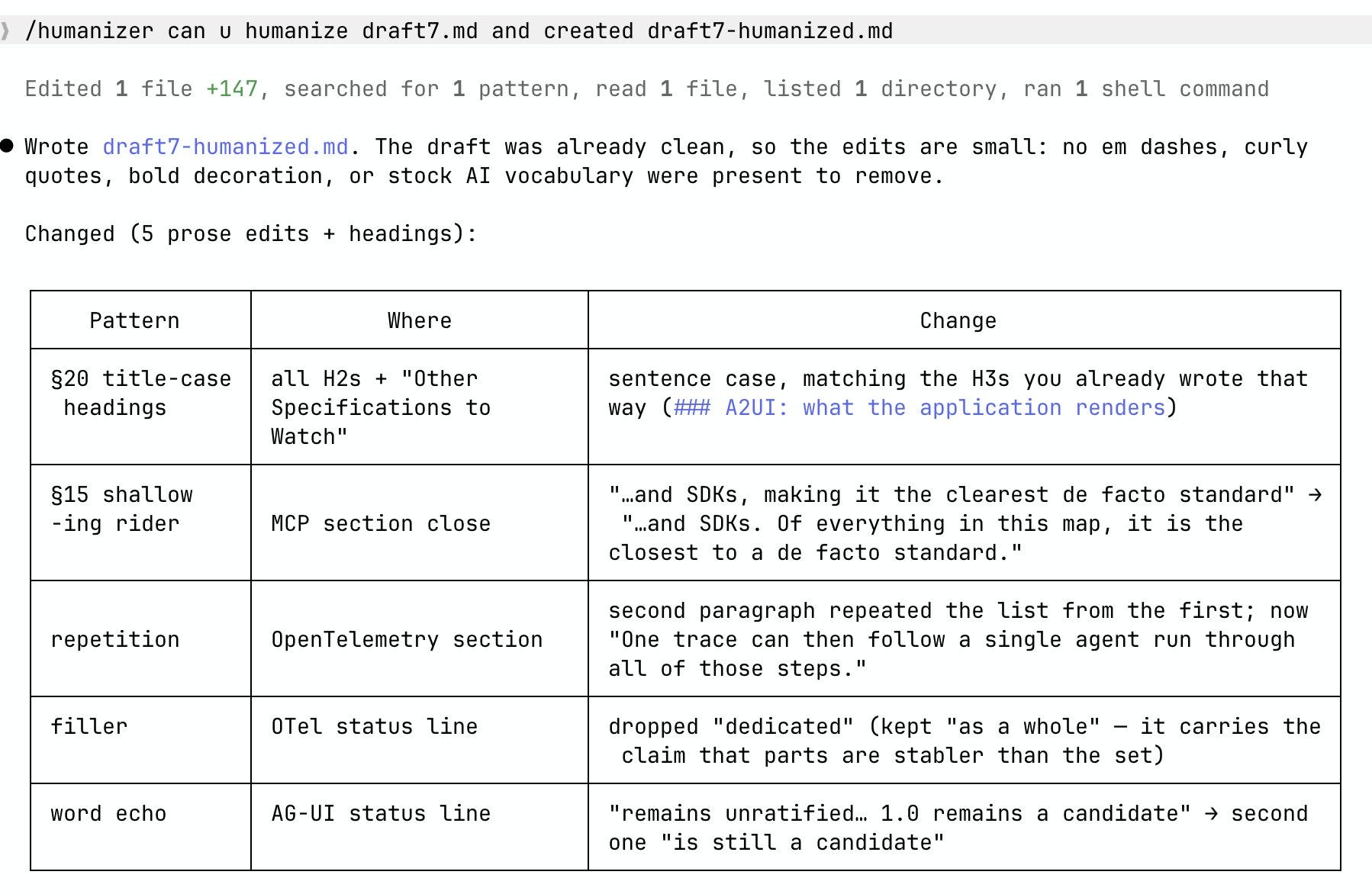
Humanizer found a short list of local problems and stopped.
Its report explains why the list was short. It found no em dashes, no decorative bold, no curly quotes, and no stock AI vocabulary to remove, so most of its 25 patterns had nothing to match. The next skill’s word checks came back just as empty.
2. No AI Slop: structural paragraph edits
No AI Slop touched 16 passages and removed 15 words. None of its listed banned words or phrases appeared in this run, so it named actors, shortened tangled sentences, removed duplicated material, and killed the recap.
Before: “cross-client portability remains to be proved”
After: “no one has proved cross-client portability yet”
This result was sharper, but one edit showed the risk. “A common adoption path starts with” became “Most teams start with.” The rewrite is more direct, yet it makes a broader factual claim than the source supports.
It gave the draft structural momentum without flattening the voice, at the cost of one sentence’s precision.
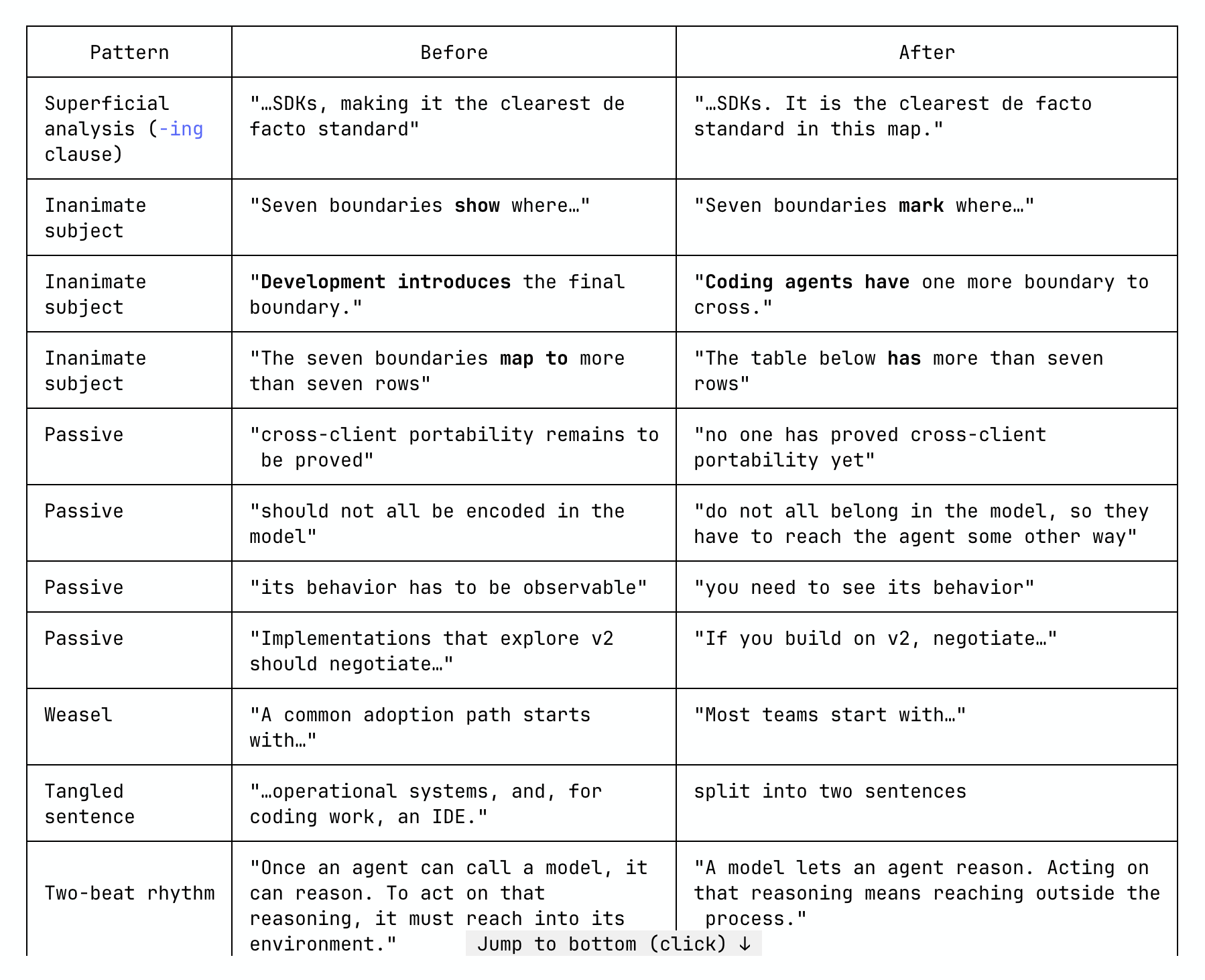
No AI Slop’s word checks stayed quiet, so it worked on structure instead.
Its own summary counted seventeen structural edits against my diff’s sixteen, the same gap between self-report and diff that Humanizer produced. The work itself was plain mechanics: inanimate subjects and passive constructions replaced, one -ing explainer split, repeated detail condensed. Stop Slop went after the same passive constructions and did not stop there.
3. Stop Slop: the strongest intervention
Stop Slop changed 37 passages, more than twice any other run, and made the draft five words longer.
The extra length comes from the rule: naming the actor behind a passive verb usually costs words.
Before: “it is not a W3C Standard”
After: “the W3C has not made it a Standard”
It also replaced “an agent’s” with “your agent’s” throughout. This was the most prescriptive result: named actors, direct reader address, fewer hedges, and fewer abstract subjects.
Explicit rules make it consistent, and the same force can flatten technical prose you wrote flat on purpose.
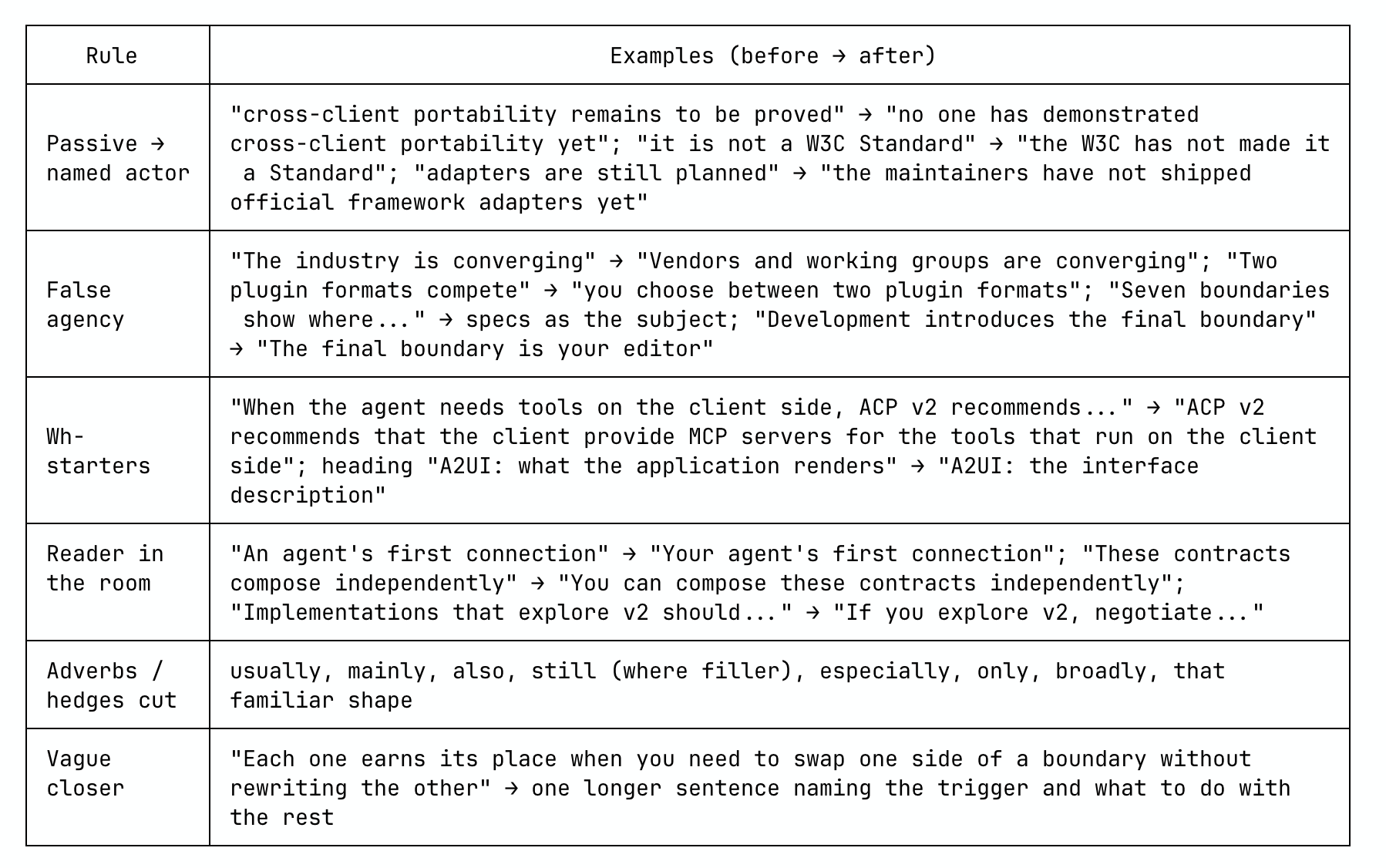
Stop Slop changed the most passages because it enforced the most rules.
The rule sheet behind that consistency is close to absolute: no adverbs, no passive voice, no Wh-word openings, two list items instead of three, no em dashes. It also reaches past grammar into abstraction, turning “The industry is converging on a different contract at each boundary” into “Vendors and working groups are converging on a different contract at each boundary.”
The run then scored itself 34/50 to 41/50 on its own five dimensions, which is a workflow score rather than independent evidence. All three skills so far began by checking the draft against a list. The fourth began somewhere else.
4. Clarity: the only one that zoomed out
Clarity changed 15 passages and removed 10 words. It was the only run whose summary explicitly diagnosed the whole piece before editing it.
From there it found a problem none of the other three summaries reported: all seven sections ended with the same verdict cadence, “X is mature, but Y remains Z.” Clarity varied those endings, reordered the lead, cut staged transitions, and removed the repeated conclusion.
It still edited sentences; that work came second.
Before: “MCP has broad support across clients, servers, and SDKs, making it the clearest de facto standard in this map.”
After: “MCP has broad support across clients, servers, and SDKs. It is the clearest de facto standard in this map.”
It reads the article before it reads the sentence.
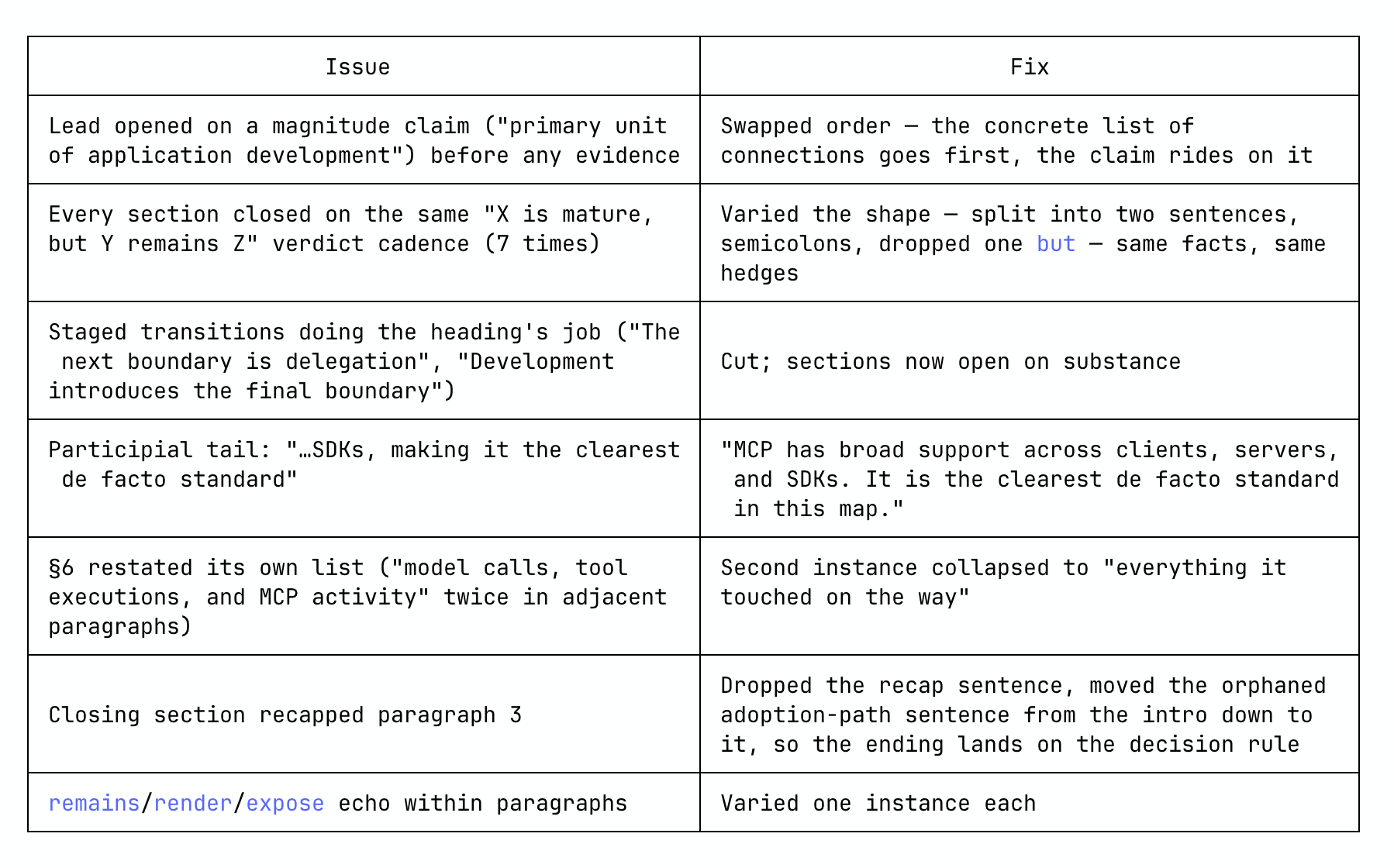
Clarity found repetition across sections, not just inside sentences.
The four runs were not disjoint. Three of them split the same shallow -ing tail and condensed the same repeated OpenTelemetry passage, and two cut the same recap ending. They converged on the local repairs and diverged on everything above them.
The takeaway
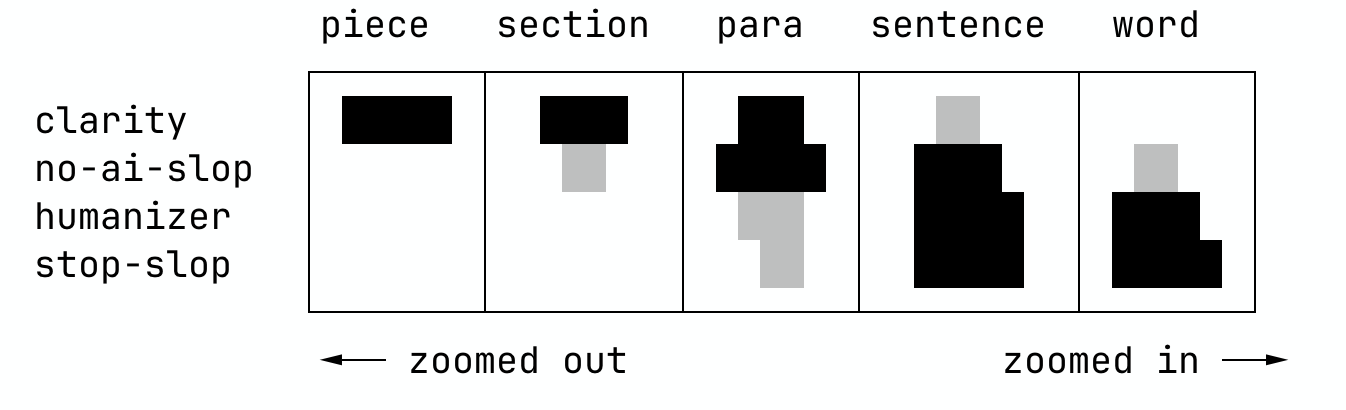
The four runs landed at different altitudes. Clarity read the piece. No AI Slop concentrated on the paragraph. Humanizer and Stop Slop spent more attention on sentences and words, from opposite ends of the same level: 14 changed passages against 37. These are observed emphases from one run, not hard capability boundaries.
The rule sheets explain those emphases better than a single score. They disagree on basic choices such as passive voice, adverbs, list length, and whether scoring belongs in the workflow.
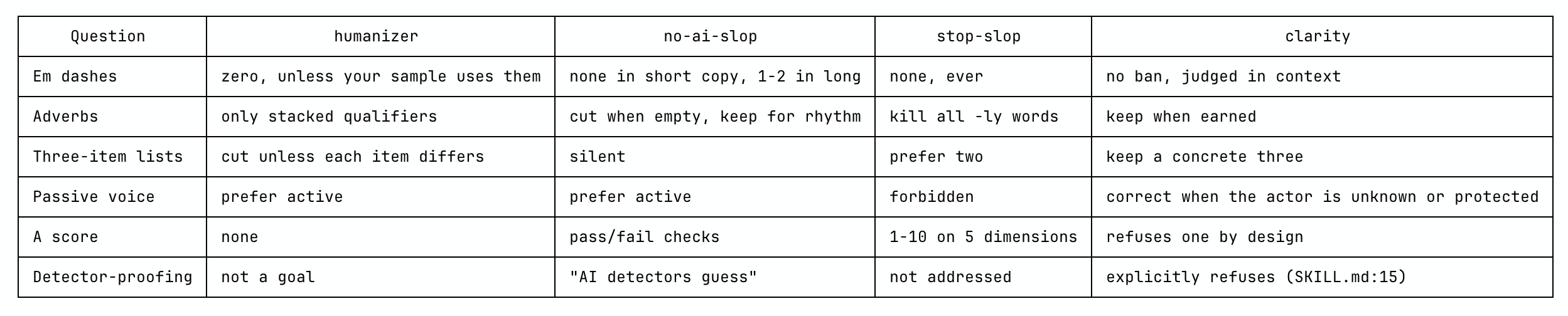
The skills disagree on editing policy, not just editing strength.
That turns the comparison into a routing decision. Start with the job, not the most aggressive rule set.
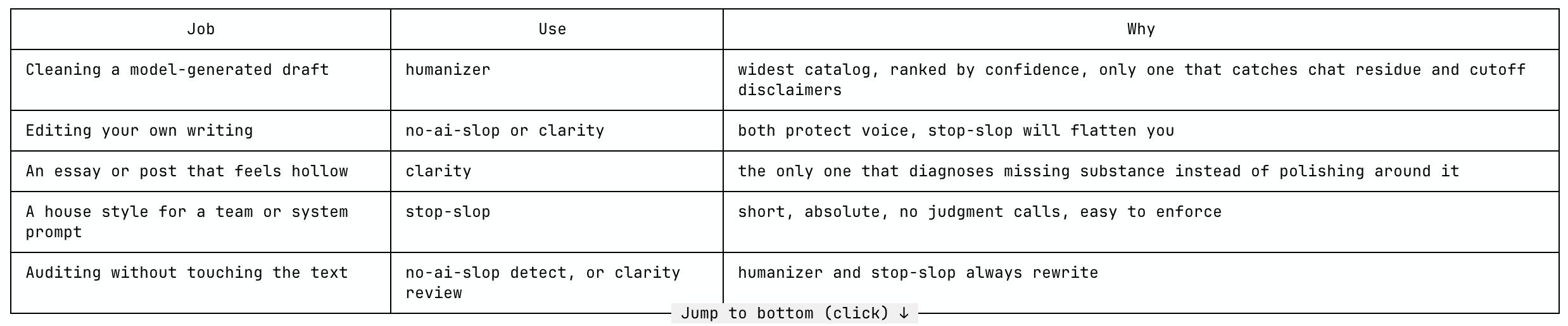
Pick the skill for the job instead of stacking all four.
Choose by the failure you want to prevent. Humanizer for conservative cleanup, No AI Slop for paragraph structure and voice, Stop Slop for explicit rule enforcement, Clarity for whole-piece diagnosis.
Stacking all four blindly is not more thorough. Their priorities can collide, and one editor can undo another’s choices. My practical rule: one skill, two at most, then I read the diff myself.
Method note: I ran the four skills separately against the same draft.md (my next post) Passage counts come from the published thread and describe one qualitative run, not quality scores or a reproducible benchmark. Star and install counts are from a 12 September 2026 snapshot and describe repositories, not writing.