

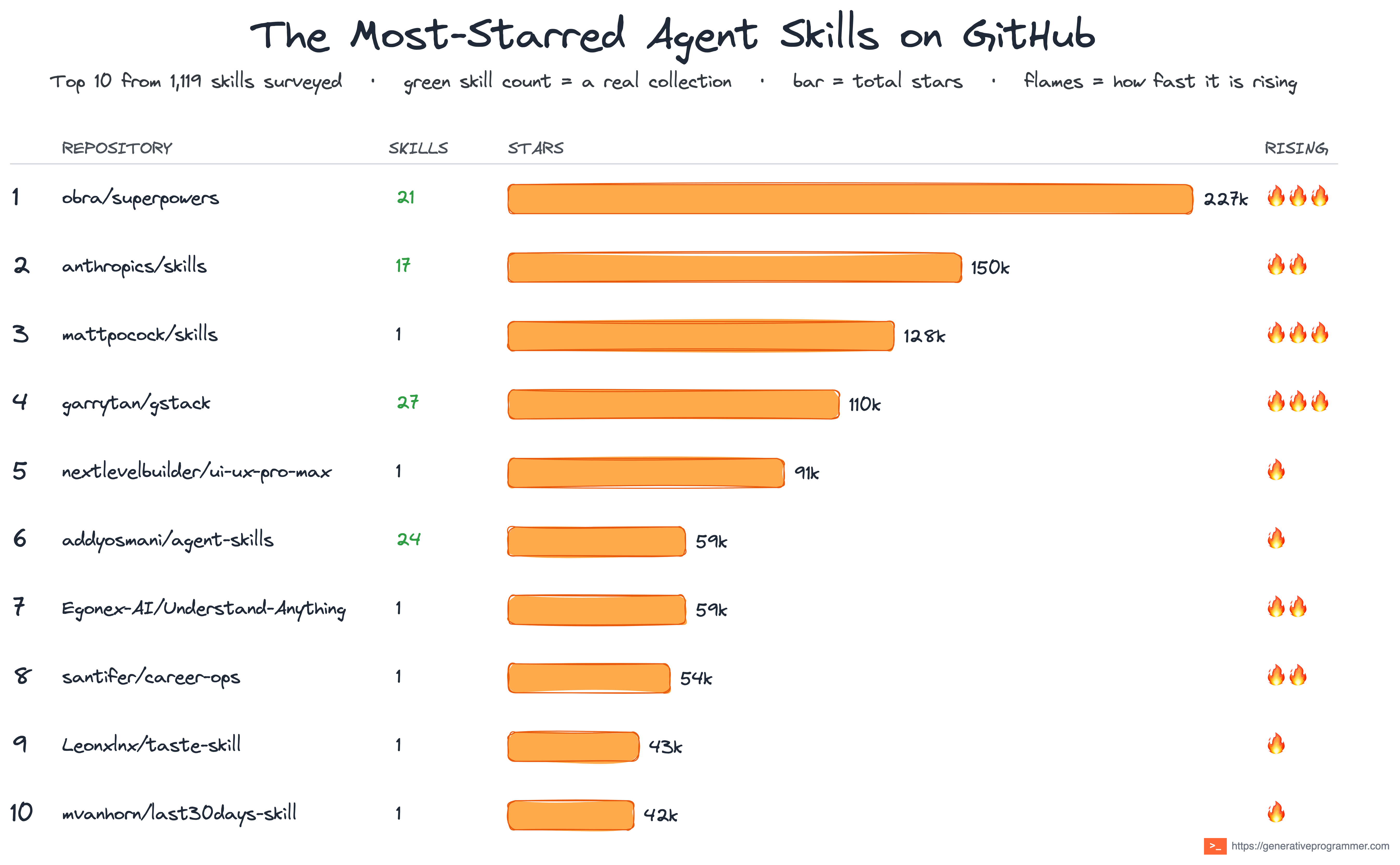
A skill is the unit of reuse for a coding agent. It is a folder with a SKILL.md that teaches the agent a capability once so you stop re-explaining it in every session, and the agent loads it only when the task calls for it. If you want the background, Anthropic’s Equipping agents for the real world with Agent Skills and the Claude Code skills docs are the two primary sources worth reading first.
This is a companion to The Agentic Coding Reading List. That list curated the people worth following. This one curates the capabilities worth installing.
The thesis: the best skill is usually the one you write for your own codebase. But you should not start from a blank folder. Install the proven ones first, learn the shape, then write your own. Every link below was checked live. Here is the shelf.
The short version
If you only want the install path, use this order:
Start with the official repositories to learn what a good
SKILL.mdlooks like.Bookmark the marketplaces and awesome lists for discovery.
Install one workflow framework before collecting individual tricks.
Add vendor skills for the stack you actually use.
Write your own skill when you repeat the same instruction three times.
Skills are going portable. They began in the Claude ecosystem, but the
SKILL.mdformat is spreading. OpenAI now documents skills in ChatGPT and Agent Skills for Codex, and several collections here already run across Claude Code, Codex, Cursor, and Gemini. Pick skills for what they do, not for one vendor.
Where to get them
Before any single skill, know where they live. Start at the source and work outward.
anthropics/skills is the official Claude repository and the right first stop. It holds the document skills that ship with Claude, the
mcp-builder, andskill-creator, which appears again at the end of this post. Reading a few of these is the fastest way to learn what a goodSKILL.mdlooks like.openai/skills is the same idea from the other side: the official skills catalog for Codex, including ready-made integrations like a Linear skill. Its existence is the clearest signal that skills are becoming a cross-agent format, not just a Claude convention.
Claude Skills Marketplace is the searchable directory of community skills, where you go when you have a specific job in mind and want to see what already exists before writing anything yourself.
Smithery is a registry for skills and MCP servers with one-command installs, for when you want to wire something up quickly rather than clone and copy files by hand.
Agensi rounds out the set as a marketplace that includes paid skills. Worth knowing the commercial layer exists, even if most of what you install will be free.
The collections I keep bookmarked
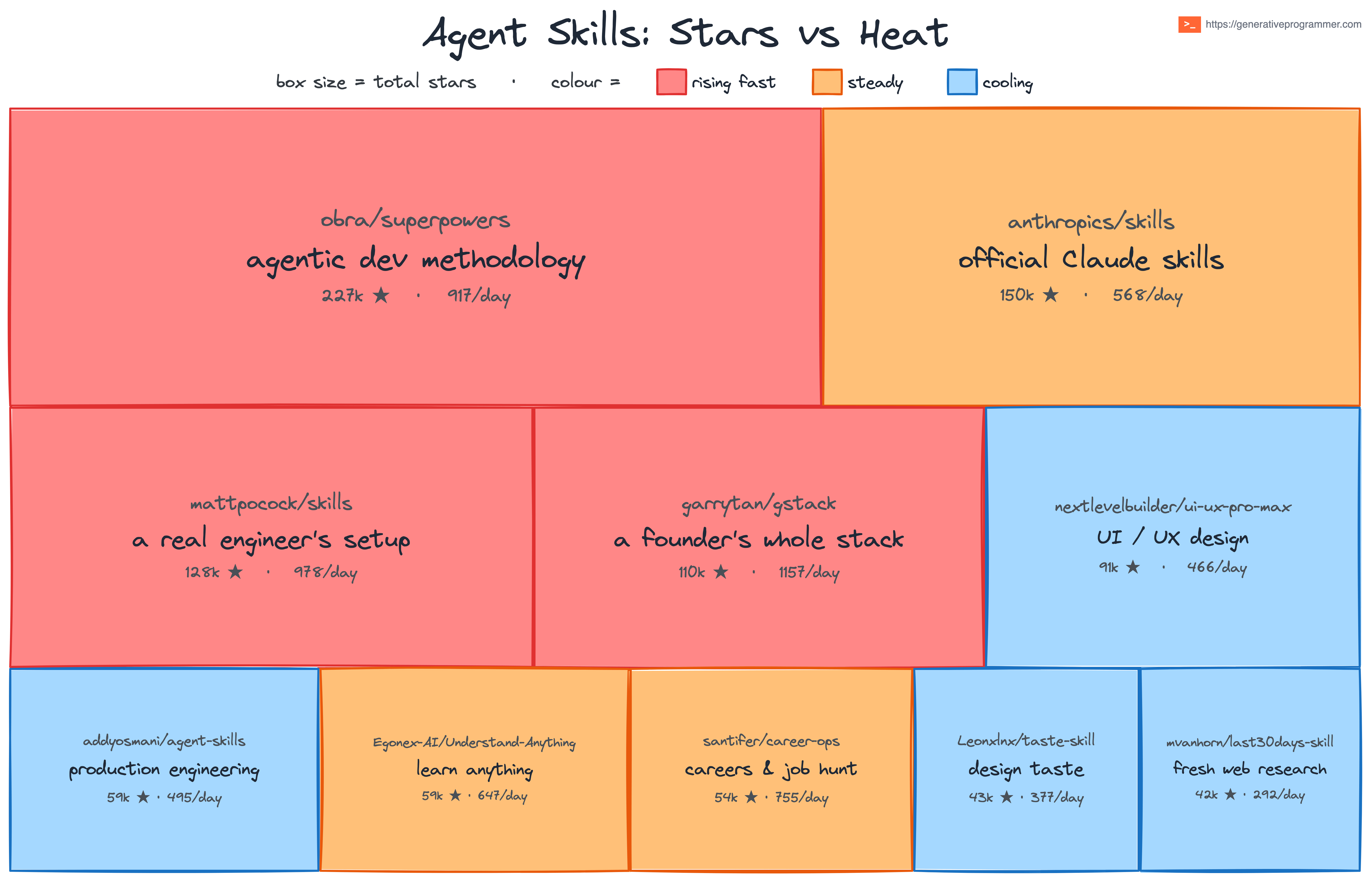
Three curated lists do the filtering for you. When a new skill trends, it usually shows up in one of these before it reaches the official repos.
ComposioHQ/awesome-claude-skills is the broad awesome list for Claude skills, resources, and tools. The first place I check when I want a map of the whole landscape.
VoltAgent/awesome-agent-skills collects over a thousand skills from official dev teams and the community, tagged by which agents they run on. Stronger on cross-CLI coverage if you are not Claude-only.
Agent-Skills-for-Context-Engineering, by Murat Can Koylan, is the focused one: skills for context engineering, multi-agent architectures, and production agent systems. Reach for it when you are building agents, not just using them.
Start with a framework, not a single skill
The highest-leverage move is not one skill but a coherent collection that brings a whole way of working. Here is what I run, plus two widely watched collections worth studying.
superpowers, by Jesse Vincent, is an agentic skills framework and development methodology rather than a loose bag of tricks. It gives the agent disciplined habits: brainstorming before building, test-driven development, systematic debugging, writing and executing plans, and asking for review at the right moments. This is the one I run daily because it changes how the agent works, not just what it knows.
andrej-karpathy-skills distills Andrej Karpathy’s observations about where language models go wrong when they write code into a single drop-in guardrail. Also installed here, and a small one with an outsized effect: it heads off common failure modes before they reach your diff.
gstack, by Garry Tan, is his exact Claude Code setup packaged for anyone to adopt: a couple of dozen opinionated tools standing in for a CEO, designer, engineering manager, release manager, and QA. Reach for it when you want a complete, pre-wired way of working rather than parts to assemble.
mattpocock/skills, by Matt Pocock, is “skills for real engineers, straight from my .claude directory.” A working practitioner’s actual setup is often more useful than anything built to be shared.
Best practices for your stack
One of the most useful categories is official skills from the tools you already build on. It points at a real shift in how vendors ship knowledge. Instead of a documentation site you are meant to read, more teams now ship a skill the agent runs: best practices made prescriptive and executable rather than left as a guide you hope someone follows.
These are the ones I install to match my own stack.
database-skills, from PlanetScale, teaches the agent to work with databases properly, schemas, queries, and migrations, instead of inventing SQL that looks right and breaks quietly. Pair it with neondatabase/agent-skills for Neon’s serverless Postgres, including a claimable Postgres skill that hands the agent a real database, and redis/agent-skills for caching done right.
next-skills, from Vercel’s engineering team, carries the frontend half, with a next-best-practices skill that keeps the agent inside the framework’s intended patterns. supabase/agent-skills does the same for the Supabase platform.
The vendor roster now reads like a stack diagram: Stripe for payments, Cloudflare for the edge, HashiCorp for Terraform, Hugging Face for models, and Trail of Bits for security, alongside Netlify, Sanity, WordPress, and Expo. Check whether the tools you depend on ship one. Increasingly, they do.
Pick a skill for your job
Past the frameworks, the rest is role-specific. Depending on what you do, grab the skill that matches your job. There are far more than these, but four map cleanly to four kinds of work. Follow this far enough and you will want one that does not exist yet, which is the next section.
Software engineers want agent-skills, from Addy Osmani: a collection of production-grade engineering skills, less a single trick than a framework for the way careful, maintainable code gets written.
Designers want open-design, by Nexu, a local-first, open alternative to Claude’s design tooling that turns the agent into something that can generate interfaces, prototypes, and slides across several agent CLIs.
Anyone who writes wants humanizer, which strips the tells out of AI-generated prose, the giveaway phrasing and rhythm that make a draft read like a machine wrote it.
Researchers and the perpetually curious want last30days-skill, by Matt Van Horn, which researches any topic across Reddit, X, YouTube, Hacker News, Polymarket, and the open web, then synthesizes a grounded summary. Not writing code, but gathering current signal before you do.
When none of these fit, build your own
Follow the list this far and you will hit the skill that should exist but does not. Once you have seen the shape of a good SKILL.md, your own repeated instructions are the next thing to capture, and two skills exist to help you do exactly that.
skill-creator is Anthropic’s skill that builds skills. It scaffolds a new one and, in the spirit of the methodology, has you run it on a few test cases and read the transcripts before you trust it.
Skill_Seekers, by Yusuf Karaaslan, comes at it from the other direction: it converts documentation sites, GitHub repositories, and PDFs into skills automatically, with conflict detection. This is the fast path when the knowledge you want already exists as docs and you just need it packaged.
Where skills and MCP blur
Not everything useful is packaged as a skill yet, and the line between a skill and an MCP server is getting thinner. Two tools make the point better than another definition.
context7, from Upstash, pulls up-to-date, version-correct documentation and code examples for a library straight into the model’s context, so the agent stops writing against an API it half-remembers from training. It is also the cleanest example of the shift: it ships as an MCP server, a CLI, and a skill. Same capability, packaged three ways, installed however your setup prefers. I keep it on.
Playwright is the same split caught live. Microsoft’s playwright-mcp is a widely used way to give an agent real browser control for automation and testing, and it is an MCP server. playwright-skill, by Jordan Lackey, rebuilds that capability as a model-invoked skill that writes and runs its own browser automation. Try both: the MCP if you want the mature option today, the skill if you want the load-only-when-needed behavior that context7 already points toward.
The takeaway
The marketplaces will tempt you with thousands of skills. That number is a trap. A handful you actually understand and trust will do more for your work than a directory you never open, the same way a short reading list of durable sources beats an endless feed.
Bookmark the collections, run a framework that changes how your agent works, add the vendor skills that match your stack, grab the one that fits your job, and then write the one that does not exist yet. That last one is the point of all the others.
Subscribe to Generative Programmer for practical maps, pattern catalogs, and production lessons for AI coding agents and agentic developer tools.
This is a living document. Last checked: 2026-06-14. If a skill here has moved or you think something essential is missing, tell me and I will update it.
Bookmarked this one. I’ve noticed the repos with real traction are almost never the flashiest agent frameworks, they’re the boring observability and eval tooling that tells you why an agent failed at 2am. Curious if you’re seeing the same skew toward tooling over frameworks in what people actually star versus what they actually use.
Nice list, thanks for prepping and sharing it.
I want to share mine, which I recently built for OpenSpec - https://github.com/sudokar/openspec-plus